
Research-Driven Loyalty Program Redesign for Nespresso
The Project
The Problem: Nespresso's top-tier "Ambassador" customers were disengaged—71% didn't even know their loyalty status, and the digital experience felt transactional compared to the premium in-store service
This was a competitive pitch project where our agency competed for Nespresso France's loyalty program redesign contract. My research and strategic framework were presented to Nespresso's VP of Digital and Head of CRM.
This project was an UX as well as Creative brief, in which I lead the prelimenary research, user testings and interviews, and wireframes.
For: Nespresso
My Role: Lead UX Designer
Tools: Figma, Sketch
FOCUS AREAS:
User Research
Data Analysis
UI Design
Personalisation UX
Product Strategy
Results
71% of surveyed members (106 total) were unaware of their loyalty status, validating the need for visibility over more rewards.
Ambassador interviews revealed top spenders felt their loyalty was invisible—driving the gamification + personalization approach.
Research findings validated stakeholder concerns and influenced Nespresso's 2022 digital loyalty strategy.
The challenge:
Nespresso France has a 3-tier membership loyalty program. They wanted to redefine their loyalty program in order to get closer to their customer base but also increase the retention of their customers, focusing on the “Ambassadors”.
The approach:
I started this project with a lay of the land, conducting a Heuristic Review of the current experience for the loyalty program. I then launched a quantitative survey to understand the relationship of users with the loyalty program. I dug deeper with 9 user interviews to gain more qualitative insights (including 4 Ambassdors). Finally, I designed a wireframe to brief an UI expert to mock up the proposed improved loyalty program screen.
The outcome:
The main takeaway from the research phase was the lack of clarity of the benefits offered to the customers, as well as the lack of knowledge of their status within the program. The experience online felt generic, impersonal and transactional, contrary to the experience in store seen as premium and personalised.
The solution:
Redesigning the member’s page to make it more personalised with specific information about the customer’s tastes and consumption habits, as well as “gamifying” the access to gifts and badges, allowed to have better clarity in terms of member’s status but also in terms of engagement thus retention.
The Research
I started this research project with a Heuristic review of the current experience of the loyalty program.
From there I launched a qualitative survey (106 respondents) to then gather more information through 9 user interviews.
Heuristic Review; Quantitative Survey; User Interviews
Heuristic Review and Audit
Focusing on the different areas throughout the member’s journey (from login to checkout) I highlighted areas of improvement to better the clarity and overall user journey.
User Survey and Interviews
With a 10-question survey and 106 respondents, I was able to grasp the consumption habits of the customers, why they chose Nespresso, see if the loyalty program had an impact on their engagement to the brand and were the expections for the brand Nespresso.
Survey results:
Out of 106 respondents, 83 were active customers
54.2% chose to buy online because of the ease of process and free delivery
61% bought in-store because of the premium experience
71.2% did not know they were part of Nespresso’s loyalty program nor did they know their status
When asked what they would like to see in the loyalty program:
1. Promotions/discounts
2. Personalisation
3. Découvertes (events, experiences, new capsules to test)
4. More/better clarity of existing benefits
The user interviews helped me gather more details into the impact of loyalty programs on customers’ engagement and their view on Nespresso’s loyalty scheme
9 interviews - 4 with the status of “Ambassador”

« Je n’arrive pas à me souvenir… ah si peut-être une réduction de 80c. J’ai cru que c’était une blague »
Translation: “I can’t remember… ah yes maybe a discount of 80p. I thought it was a joke”

« La dernière fois, j’ai reçu un coffret découverte, alors c’est très gentil mais sur 10 capsules « à découvrir », j’en connaissais déjà 8 ! »
Translation: “The last time, I received a discovery box, it was really nice but out of 10 capsules “to discover”, I already knew 8!”

« Je suis cliente Nespresso pour la qualité du café mais j’achète toujours les mêmes car je ne sais pas ce qu’il y a d’autre et n’ai pas le temps de chercher »
Translation: “I am a customer of Nespresso for the quality of coffee but I always buy the same ones because I don’t know what else is available and I don’t have time to look for it myself”
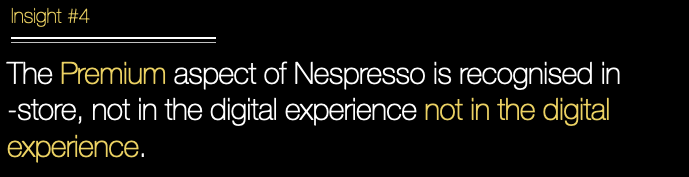
« La boutique Nespresso est une expérience premium, on se sent chouchouté. Par contre j’utilise le site comme un site d’e-commerce, juste pour passer commande. »
Translation: “The Nespresso store offers a premium experience, you feel pampered. However, I use the website like any other e-commerce website, to buy.”
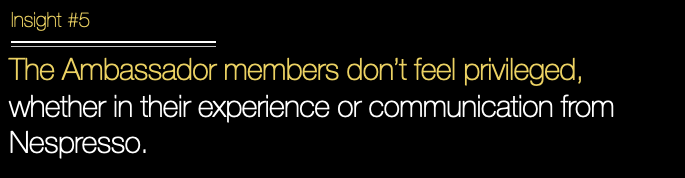
« Je suis sûrement ambassadeur [vu ma consommation] mais je ne le sais pas et je ne l’ai jamais ressenti. »
Translation: “I should be ambassador [given my consumption] but I don’t know and I’ve never felt like it.”
The Solution
From the research, it was clear that we needed to add personalisation, recommendations and status clarity on both member status and benefits.
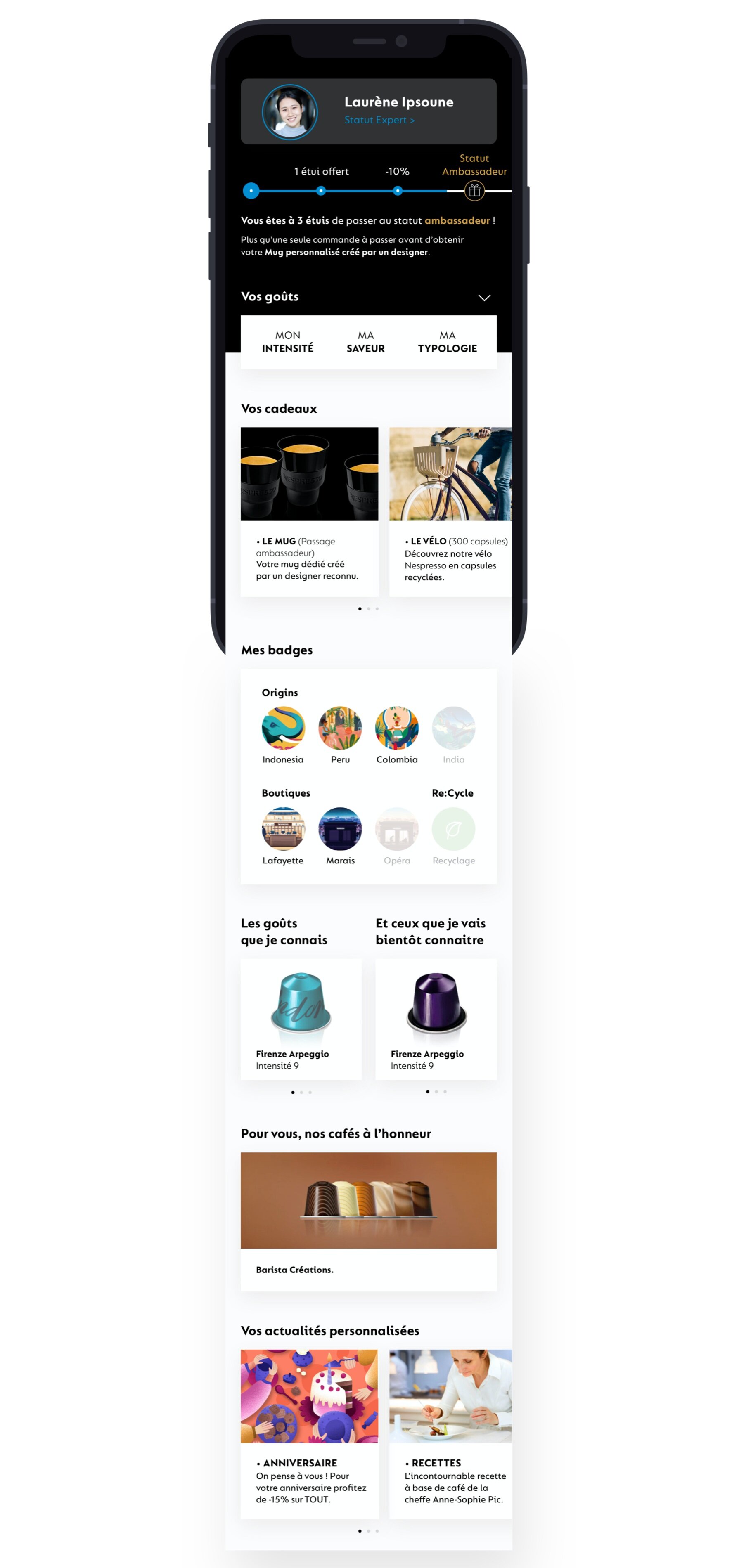
Personalisation:
Profile picture
Color code tied to status
Taste profile
Badges
Known flavors
Articles
Recommendations:
Coffee recommendations according to taste profile
Coffee discovery recommendations according to taste
Gift recommendations according to consumption
Clarity:
Color code tied to status
Link to full benefits of current status
Progress bar to unlock next status/benefit
Available gifts tied to status and needed consumption to unlock
Unlocked benefit pop-up
Reflection & What I Learned
This pitch project validated a principle that shapes how I approach every loyalty or retention challenge: when 71% of your top-tier customers don't know they're top-tier, you don't have a design problem—you have a strategy problem.
The research insight—that Ambassadors felt invisible despite spending €1000+/year—reframed the entire brief. Instead of "redesign the loyalty page," it became "make status unmissable and rewards feel earned." That shift from tactical execution to strategic recommendation is what pitch work demands.
Working within constraints:
The 4-week timeline meant I couldn't validate personas with actual users, only with stakeholder knowledge and CRM data. In an ideal scenario, I would have conducted 8-10 user interviews across tiers. However, the constraint forced a pragmatic approach: leverage existing customer data, validate assumptions through survey scale (106 responses), then de-risk with rapid wireframe testing internally.
The broader insight:
Loyalty isn't built through features alone—it's built when digital experiences match brand promises. Nespresso's in-store experience was premium and personalized; their digital experience was transactional. Closing that gap became the north star.
Since this project, I ask every product team: "Does our digital experience feel consistent with our brand promise?" That question—applied to B2B SaaS, consumer products, or enterprise tools—drives better design decisions than "Does this look good?"